

Sanofi’s portfolio value and patient support
Select a card below to explore Cerezyme information by topic
,
Understand the healthcare utilization and economic burden associated with managing GD3
Retrospective, observational study of a US database from 2007 to 2020 provided insight into the economics of managing Gaucher disease type 3 (GD3)1

94
Median number of specialist visits over ≥3 years.

41
Median number of prescription fills in the 12 months following diagnosis.

33%
Percentage of records showing an emergency department visit within 12 months of diagnosis.
*Analyses are speculative and make no comparison regarding safety, efficacy, or clinical outcomes
,.
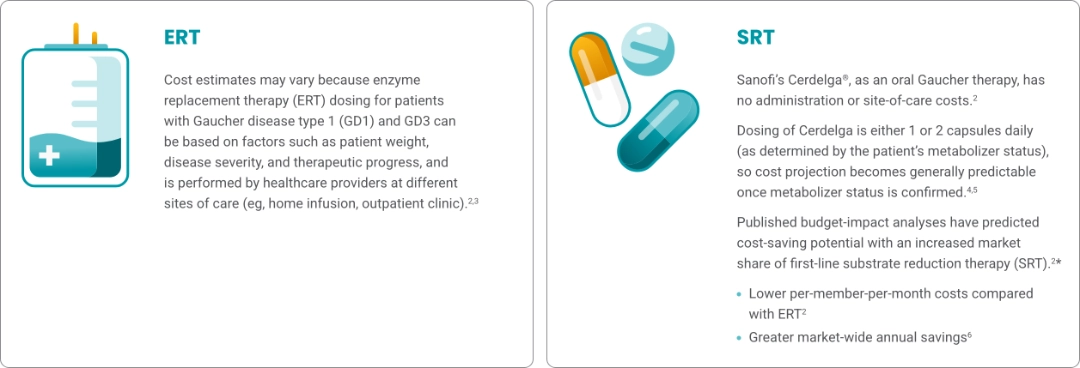
Evaluate ERT and SRT considerations that may inform access and cost planning for Gaucher disease

The Gaucher Registry (sponsored by Sanofi)
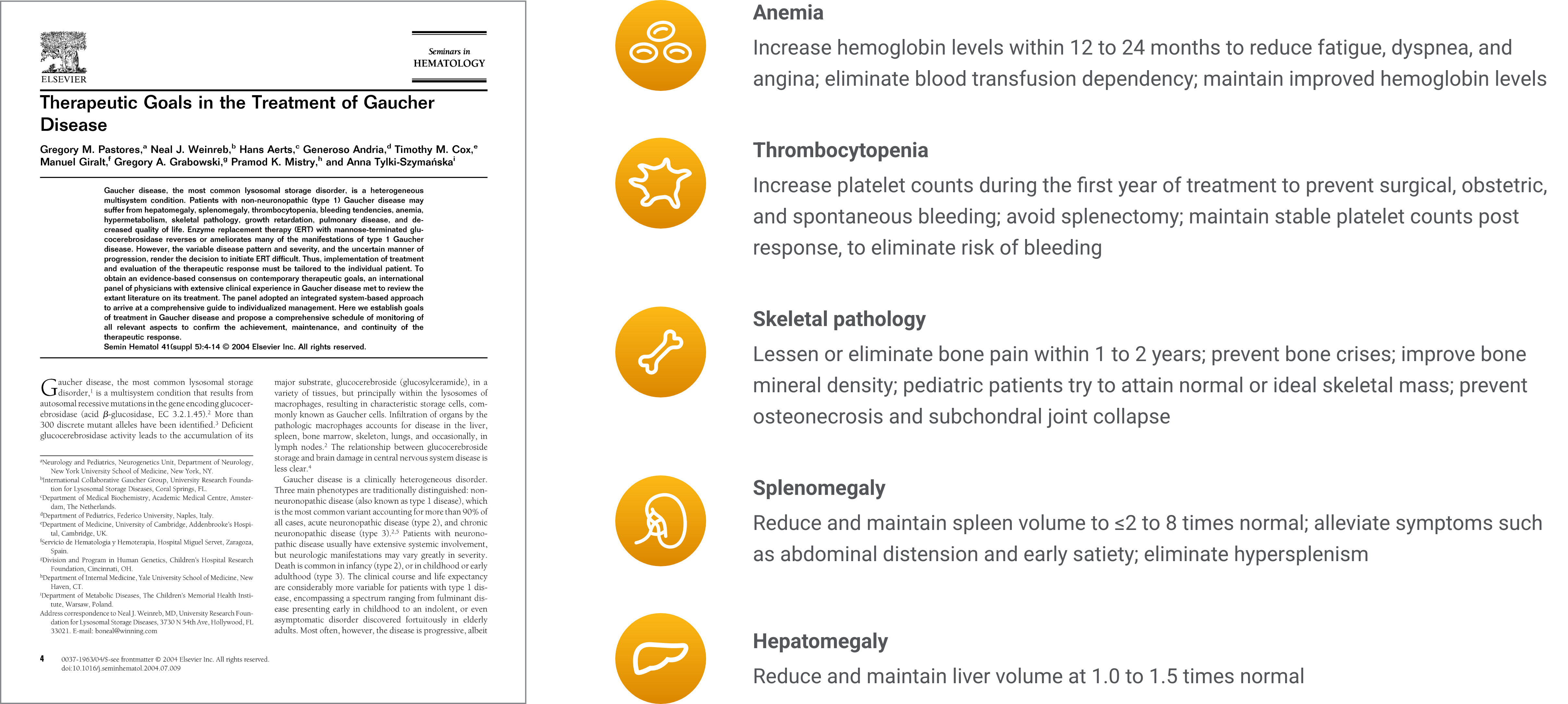
The Gaucher Registry, established by the International Collaborative Gaucher Group (ICGG) in 1991, is the world’s largest longitudinal database tracking real-world outcomes in Gaucher disease—providing the long-term evidence base that informs treatment decisions and therapeutic goal-setting.
Consensus Therapeutic goals
Consensus therapeutic goals across 5 major domains
The ICGG has established goals for:
Review Gaucher support resources and GD3-specific FAQs to help inform access planning and continuity of care

CareConnect patient support services provide personalized assistance to help patients navigate access, coverage, and treatment coordination—building on Sanofi’s 40-year commitment to the Gaucher disease community
Resources include:
 Dedicated CareConnect Case Managers and Patient Education Liaisons
 Disease-specific information and resources, including information about how rare diseases may run in families
 Care coordination for treatment
Q: How can I assess the budget impact of an expanded indication for Cerezyme?
A: The rarity of Gaucher disease alone suggests the overall budget impact of a new label for Cerezyme should be minimal. Because the treatment regimen for both GD1 and GD3 is highly individualized, assessing budget impact of Cerezyme needs to be done on a case-by-case basis.
- Dosing can be based on factors such as patient weight, disease severity, and therapeutic progress
- Treatment can be administered at various sites that impact cost (eg, home infusion vs outpatient)
In addition, budget impact may be mitigated by the fact that many existing policies specify coverage of Cerezyme to treat GD3—meaning the new indication would not materially affect your current patient mix.
Q: Are any of the usage codes changing based on the inclusion of GD3?
A: No, GD3 uses the same HCPCS code as all other subtypes of Gaucher (J1786), so policies do not need to be updated. Similarly, the ICD-10 code for diagnosis of Gaucher disease, E75.22, applies to all subtypes of the disease and should be used for GD3. Finally, the 400-unit, single-dose vial of Cerezyme is used for both GD1 and GD3, so there is only one NDC: 58468-4663-1.
HCPCS, Healthcare Common Procedure Coding System; ICD-10, International Classification of Diseases, Tenth Revision; NDC, National Drug Code.
,

References: 1. Rochmann C, Nanaï A, Bianculli P, et al. Describing the natural history and burden of illness in patients with Gaucher’s disease type 3 using a cluster from Optum’s de-identified Market Clarity data (2007–2020). Poster presented at: 19th annual WORLDSymposium; February 22-26, 2023; Orlando, FL. Poster 308. 2. Nalysnyk L, Sugarman R, Cele C, Uyei J, Ward A. Budget impact analysis of eliglustat for the treatment of Gaucher disease type 1 in the United States. J Manag Care Spec Pharm. 2018;24(10):1002-1008. doi:10.18553/jmcp.2018.24.10.1002 3. Cerezyme. Prescribing information. Genzyme Corporation; 2026. 4. CERDELGA. Prescribing information. Genzyme Corporation; 2024. 5. Crowe S, Raetz K, Parker J, Teng E. 2023 Rare & Specialty Trend Report. 4th ed. Alnylam Pharmaceuticals; 2024. 6. Rochmann C, Fournier M, Hull J, Perichon M, Pulikottil-Jacob R. Re: The budget impact of enzyme replacement therapy in type 1 Gaucher disease in the United States. J Med Econ. 2023;26(1):627-629. doi:10.1080/13696998.2023.2197812
INDICATION FOR CEREZYME
Cerezyme® (imiglucerase) for injection is indicated for the treatment of non-central nervous system (CNS) manifestations of Type 1 or Type 3 Gaucher disease in adult and pediatric patients.
INDICATION FOR CERDELGA
CERDELGA is indicated for the long-term treatment of adult patients with Gaucher disease type 1 (GD1) who are CYP2D6 extensive metabolizers (EMs), intermediate metabolizers (IMs), or poor metabolizers (PMs) as detected by an FDA-cleared test.
Limitations of Use:
- Patients who are CYP2D6 ultra-rapid metabolizers (URMs) may not achieve adequate concentrations of CERDELGA to achieve a therapeutic effect.
- A specific dosage cannot be recommended for those patients whose CYP2D6 genotype cannot be determined (indeterminate metabolizers).
Important Safety Information for Cerezyme:
WARNING: HYPERSENSITIVITY REACTIONS INCLUDING ANAPHYLAXIS
Patients treated with enzyme replacement therapies have experienced life-threatening hypersensitivity reactions, including anaphylaxis. Anaphylaxis has occurred during the early course of enzyme replacement therapy and after extended duration of therapy.
Initiate CEREZYME in a healthcare setting with appropriate medical monitoring and support measures, including cardiopulmonary resuscitation equipment. If a severe hypersensitivity reaction (e.g., anaphylaxis) occurs, discontinue CEREZYME immediately, and initiate appropriate medical treatment, including use of epinephrine. Inform patients of the symptoms of life-threatening hypersensitivity reactions, including anaphylaxis, and to seek immediate medical care should symptoms occur.
Warnings and Precautions:
Hypersensitivity Reactions Including Anaphylaxis: See Boxed WARNING.
Patients with antibody to imiglucerase have a higher risk of hypersensitivity reactions. Consider periodic monitoring during the first year of treatment for lgG antibody formation.
Consider risks and benefits of readministering Cerezyme to individual patients following a severe reaction. If a mild or moderate hypersensitivity reaction occurs, consider reducing the rate of infusion, pretreat with antihistamines and/or corticosteroids, and monitor patients for new signs and symptoms of a hypersensitivity reaction.
Infusion-Associated Reactions:
Infusion associated reactions (IARs) have been observed in patients treated with Cerezyme. If a severe IAR occurs, discontinue CEREZYME and immediately initiate appropriate medical treatment. Consider the risks and benefits of re-administering CEREZYME following a severe IAR. If a mild or moderate IAR occurs, consider decreasing the infusion rate, temporarily stopping the infusion, and/or administering antihistamines, antipyretics, and/or corticosteroids.
Adverse Reactions:
- Adverse reactions reported in adults and pediatric patients include back pain, chills, dizziness, fatigue, headache, hypersensitivity reactions, nausea, pyrexia, and vomiting.
Please see accompanying Full Prescribing Information, including Boxed WARNING.
IMPORTANT SAFETY INFORMATION FOR CERDELGA
CONTRAINDICATIONS
CERDELGA is contraindicated in the following patients based on CYP2D6 metabolizer status due to the risk of cardiac arrhythmias from prolongation of the PR, QTc, and/or QRS cardiac intervals:
- Extensive Metabolizers (EMs) taking a strong or moderate CYP2D6 inhibitor concomitantly with a strong or moderate CYP3A inhibitor, EMs with moderate or severe hepatic impairment, or EMs with mild hepatic impairment and taking a strong or moderate CYP2D6 inhibitor.
- Intermediate Metabolizers (IMs) taking a strong or moderate CYP2D6 inhibitor concomitantly with a strong or moderate CYP3A inhibitor, IMs taking a strong CYP3A inhibitor, or IMs with any degree of hepatic impairment.
- Poor Metabolizers (PMs) taking a strong CYP3A inhibitor, or PMs with any degree of hepatic impairment.
WARNINGS AND PRECAUTIONS
CERDELGA is predicted to cause increases in ECG intervals (PR, QTc, and QRS) at substantially elevated plasma concentrations and may increase risk of cardiac arrhythmias. Use of CERDELGA is contraindicated, to be avoided, or requires dosage adjustment in patients taking CYP2D6 or CYP3A inhibitors, depending on CYP2D6 metabolizer status, type of inhibitor, or degree of hepatic impairment. Avoid use of CERDELGA in patients with pre-existing cardiac disease, long QT syndrome, or in combination with Class IA or Class III antiarrhythmic medications.
Adverse Reactions
The most common adverse reactions (≥10%) to CERDELGA include: fatigue, headache, nausea, diarrhea, back pain, pain in extremities, and upper abdominal pain.
DRUG INTERACTIONS
Coadministration of CERDELGA with CYP2D6 or CYP3A inhibitors may increase eliglustat concentrations, which may increase the risk of cardiac arrhythmias from prolongations of the PR, QTc, and/or QRS cardiac interval. Use of CERDELGA is contraindicated, to be avoided, or may require dosage adjustment depending on the concomitant drug and CYP2D6 metabolizer status. See section 7 of the full Prescribing Information for more details and other potentially significant drug interactions.
USE IN SPECIFIC POPULATIONS
Available data on the use of CERDELGA in pregnant women is not sufficient to assess drug-associated risks of major birth defects, miscarriage, or adverse maternal or fetal outcomes. The developmental and health benefits of breastfeeding should be considered along with the mother’s clinical need for CERDELGA and any potential adverse effects on the breastfed child from CERDELGA or from the underlying maternal condition.
Use of CERDELGA in patients with renal impairment is based on the patient’s CYP2D6 metabolizer status. Avoid use of CERDELGA in EMs with end-stage renal disease (ESRD), and IMs and PMs with any degree of renal impairment.
Use of CERDELGA is contraindicated or may require dosage adjustment in patients with hepatic impairment based on CYP2D6 metabolizer status, concomitant use of CYP2D6 or CYP3A inhibitors, and degree of hepatic impairment.
Please see accompanying full Prescribing Information.
INDICATION FOR CEREZYME
Cerezyme® (imiglucerase) for injection is indicated for the treatment of non-central nervous system (CNS) manifestations of Type 1 or Type 3 Gaucher disease in adult and pediatric patients.
INDICATION FOR CERDELGA
CERDELGA is indicated for the long-term treatment of adult patients with Gaucher disease type 1 (GD1) who are CYP2D6 extensive metabolizers (EMs), intermediate metabolizers (IMs), or poor metabolizers (PMs) as detected by an FDA-cleared test.
Limitations of Use:
- Patients who are CYP2D6 ultra-rapid metabolizers (URMs) may not achieve adequate concentrations of CERDELGA to achieve a therapeutic effect.
- A specific dosage cannot be recommended for those patients whose CYP2D6 genotype cannot be determined (indeterminate metabolizers).
Important Safety Information for Cerezyme:
WARNING: HYPERSENSITIVITY REACTIONS INCLUDING ANAPHYLAXIS
Patients treated with enzyme replacement therapies have experienced life-threatening hypersensitivity reactions, including anaphylaxis. Anaphylaxis has occurred during the early course of enzyme replacement therapy and after extended duration of therapy.
Initiate CEREZYME in a healthcare setting with appropriate medical monitoring and support measures, including cardiopulmonary resuscitation equipment. If a severe hypersensitivity reaction (e.g., anaphylaxis) occurs, discontinue CEREZYME immediately, and initiate appropriate medical treatment, including use of epinephrine. Inform patients of the symptoms of life-threatening hypersensitivity reactions, including anaphylaxis, and to seek immediate medical care should symptoms occur.
Warnings and Precautions:
Hypersensitivity Reactions Including Anaphylaxis: See Boxed WARNING.
Patients with antibody to imiglucerase have a higher risk of hypersensitivity reactions. Consider periodic monitoring during the first year of treatment for lgG antibody formation.
Consider risks and benefits of readministering Cerezyme to individual patients following a severe reaction. If a mild or moderate hypersensitivity reaction occurs, consider reducing the rate of infusion, pretreat with antihistamines and/or corticosteroids, and monitor patients for new signs and symptoms of a hypersensitivity reaction.
Infusion-Associated Reactions:
Infusion associated reactions (IARs) have been observed in patients treated with Cerezyme. If a severe IAR occurs, discontinue CEREZYME and immediately initiate appropriate medical treatment. Consider the risks and benefits of re-administering CEREZYME following a severe IAR. If a mild or moderate IAR occurs, consider decreasing the infusion rate, temporarily stopping the infusion, and/or administering antihistamines, antipyretics, and/or corticosteroids.
Adverse Reactions:
- Adverse reactions reported in adults and pediatric patients include back pain, chills, dizziness, fatigue, headache, hypersensitivity reactions, nausea, pyrexia, and vomiting.
Please see accompanying Full Prescribing Information, including Boxed WARNING.
IMPORTANT SAFETY INFORMATION FOR CERDELGA
CONTRAINDICATIONS
CERDELGA is contraindicated in the following patients based on CYP2D6 metabolizer status due to the risk of cardiac arrhythmias from prolongation of the PR, QTc, and/or QRS cardiac intervals:
- Extensive Metabolizers (EMs) taking a strong or moderate CYP2D6 inhibitor concomitantly with a strong or moderate CYP3A inhibitor, EMs with moderate or severe hepatic impairment, or EMs with mild hepatic impairment and taking a strong or moderate CYP2D6 inhibitor.
- Intermediate Metabolizers (IMs) taking a strong or moderate CYP2D6 inhibitor concomitantly with a strong or moderate CYP3A inhibitor, IMs taking a strong CYP3A inhibitor, or IMs with any degree of hepatic impairment.
- Poor Metabolizers (PMs) taking a strong CYP3A inhibitor, or PMs with any degree of hepatic impairment.
WARNINGS AND PRECAUTIONS
CERDELGA is predicted to cause increases in ECG intervals (PR, QTc, and QRS) at substantially elevated plasma concentrations and may increase risk of cardiac arrhythmias. Use of CERDELGA is contraindicated, to be avoided, or requires dosage adjustment in patients taking CYP2D6 or CYP3A inhibitors, depending on CYP2D6 metabolizer status, type of inhibitor, or degree of hepatic impairment. Avoid use of CERDELGA in patients with pre-existing cardiac disease, long QT syndrome, or in combination with Class IA or Class III antiarrhythmic medications.
Adverse Reactions
The most common adverse reactions (≥10%) to CERDELGA include: fatigue, headache, nausea, diarrhea, back pain, pain in extremities, and upper abdominal pain.
DRUG INTERACTIONS
Coadministration of CERDELGA with CYP2D6 or CYP3A inhibitors may increase eliglustat concentrations, which may increase the risk of cardiac arrhythmias from prolongations of the PR, QTc, and/or QRS cardiac interval. Use of CERDELGA is contraindicated, to be avoided, or may require dosage adjustment depending on the concomitant drug and CYP2D6 metabolizer status. See section 7 of the full Prescribing Information for more details and other potentially significant drug interactions.
USE IN SPECIFIC POPULATIONS
Available data on the use of CERDELGA in pregnant women is not sufficient to assess drug-associated risks of major birth defects, miscarriage, or adverse maternal or fetal outcomes. The developmental and health benefits of breastfeeding should be considered along with the mother’s clinical need for CERDELGA and any potential adverse effects on the breastfed child from CERDELGA or from the underlying maternal condition.
Use of CERDELGA in patients with renal impairment is based on the patient’s CYP2D6 metabolizer status. Avoid use of CERDELGA in EMs with end-stage renal disease (ESRD), and IMs and PMs with any degree of renal impairment.
Use of CERDELGA is contraindicated or may require dosage adjustment in patients with hepatic impairment based on CYP2D6 metabolizer status, concomitant use of CYP2D6 or CYP3A inhibitors, and degree of hepatic impairment.
Please see accompanying full Prescribing Information.
INDICATION FOR CEREZYME
Cerezyme® (imiglucerase) for injection is indicated for the treatment of non-central nervous system (CNS) manifestations of Type 1 or Type 3 Gaucher disease in adult and pediatric patients.
INDICATION FOR CERDELGA
CERDELGA is indicated for the long-term treatment of adult patients with Gaucher disease type 1 (GD1) who are CYP2D6 extensive metabolizers (EMs), intermediate metabolizers (IMs), or poor metabolizers (PMs) as detected by an FDA-cleared test.
Limitations of Use:
- Patients who are CYP2D6 ultra-rapid metabolizers (URMs) may not achieve adequate concentrations of CERDELGA to achieve a therapeutic effect.
- A specific dosage cannot be recommended for those patients whose CYP2D6 genotype cannot be determined (indeterminate metabolizers).
Important Safety Information for Cerezyme:
WARNING: HYPERSENSITIVITY REACTIONS INCLUDING ANAPHYLAXIS
Patients treated with enzyme replacement therapies have experienced life-threatening hypersensitivity reactions, including anaphylaxis. Anaphylaxis has occurred during the early course of enzyme replacement therapy and after extended duration of therapy.
Initiate CEREZYME in a healthcare setting with appropriate medical monitoring and support measures, including cardiopulmonary resuscitation equipment. If a severe hypersensitivity reaction (e.g., anaphylaxis) occurs, discontinue CEREZYME immediately, and initiate appropriate medical treatment, including use of epinephrine. Inform patients of the symptoms of life-threatening hypersensitivity reactions, including anaphylaxis, and to seek immediate medical care should symptoms occur.
Warnings and Precautions:
Hypersensitivity Reactions Including Anaphylaxis: See Boxed WARNING.
Patients with antibody to imiglucerase have a higher risk of hypersensitivity reactions. Consider periodic monitoring during the first year of treatment for lgG antibody formation.
Consider risks and benefits of readministering Cerezyme to individual patients following a severe reaction. If a mild or moderate hypersensitivity reaction occurs, consider reducing the rate of infusion, pretreat with antihistamines and/or corticosteroids, and monitor patients for new signs and symptoms of a hypersensitivity reaction.
Infusion-Associated Reactions:
Infusion associated reactions (IARs) have been observed in patients treated with Cerezyme. If a severe IAR occurs, discontinue CEREZYME and immediately initiate appropriate medical treatment. Consider the risks and benefits of re-administering CEREZYME following a severe IAR. If a mild or moderate IAR occurs, consider decreasing the infusion rate, temporarily stopping the infusion, and/or administering antihistamines, antipyretics, and/or corticosteroids.
Adverse Reactions:
- Adverse reactions reported in adults and pediatric patients include back pain, chills, dizziness, fatigue, headache, hypersensitivity reactions, nausea, pyrexia, and vomiting.
Please see accompanying Full Prescribing Information, including Boxed WARNING.
IMPORTANT SAFETY INFORMATION FOR CERDELGA
CONTRAINDICATIONS
CERDELGA is contraindicated in the following patients based on CYP2D6 metabolizer status due to the risk of cardiac arrhythmias from prolongation of the PR, QTc, and/or QRS cardiac intervals:
- Extensive Metabolizers (EMs) taking a strong or moderate CYP2D6 inhibitor concomitantly with a strong or moderate CYP3A inhibitor, EMs with moderate or severe hepatic impairment, or EMs with mild hepatic impairment and taking a strong or moderate CYP2D6 inhibitor.
- Intermediate Metabolizers (IMs) taking a strong or moderate CYP2D6 inhibitor concomitantly with a strong or moderate CYP3A inhibitor, IMs taking a strong CYP3A inhibitor, or IMs with any degree of hepatic impairment.
- Poor Metabolizers (PMs) taking a strong CYP3A inhibitor, or PMs with any degree of hepatic impairment.
WARNINGS AND PRECAUTIONS
CERDELGA is predicted to cause increases in ECG intervals (PR, QTc, and QRS) at substantially elevated plasma concentrations and may increase risk of cardiac arrhythmias. Use of CERDELGA is contraindicated, to be avoided, or requires dosage adjustment in patients taking CYP2D6 or CYP3A inhibitors, depending on CYP2D6 metabolizer status, type of inhibitor, or degree of hepatic impairment. Avoid use of CERDELGA in patients with pre-existing cardiac disease, long QT syndrome, or in combination with Class IA or Class III antiarrhythmic medications.
Adverse Reactions
The most common adverse reactions (≥10%) to CERDELGA include: fatigue, headache, nausea, diarrhea, back pain, pain in extremities, and upper abdominal pain.
DRUG INTERACTIONS
Coadministration of CERDELGA with CYP2D6 or CYP3A inhibitors may increase eliglustat concentrations, which may increase the risk of cardiac arrhythmias from prolongations of the PR, QTc, and/or QRS cardiac interval. Use of CERDELGA is contraindicated, to be avoided, or may require dosage adjustment depending on the concomitant drug and CYP2D6 metabolizer status. See section 7 of the full Prescribing Information for more details and other potentially significant drug interactions.
USE IN SPECIFIC POPULATIONS
Available data on the use of CERDELGA in pregnant women is not sufficient to assess drug-associated risks of major birth defects, miscarriage, or adverse maternal or fetal outcomes. The developmental and health benefits of breastfeeding should be considered along with the mother’s clinical need for CERDELGA and any potential adverse effects on the breastfed child from CERDELGA or from the underlying maternal condition.
Use of CERDELGA in patients with renal impairment is based on the patient’s CYP2D6 metabolizer status. Avoid use of CERDELGA in EMs with end-stage renal disease (ESRD), and IMs and PMs with any degree of renal impairment.
Use of CERDELGA is contraindicated or may require dosage adjustment in patients with hepatic impairment based on CYP2D6 metabolizer status, concomitant use of CYP2D6 or CYP3A inhibitors, and degree of hepatic impairment.
Please see accompanying full Prescribing Information.
This site is intended for US payers only.
© 2026 Sanofi. All rights reserved.
Cerezyme and Sanofi are registered trademarks of Sanofi or an affiliate.
CareConnect Personalized Support Services is a trademark of Sanofi or an affiliate.
Leave site modal

You are about to leave SanofiMarketAccess website.
Sanofi does not review or control the content of non-Sanofi websites.