


LOPD: Treatment landscape
About LOPD
Pompe disease is a rare, inherited, degenerative muscle disease that presents with a clinical spectrum of disease manifestations.1,2 The estimated incidence of all Pompe is ~2.5 per 100,000.3,4 LOPD is one of the 2 subclassifications of Pompe disease.3,5

All lysosomal storage disorders (LSDs)
(~50 identified)
Incidence:
~12.5/100,000 live births6

Pompe disease
Estimated incidence:
~2.5/100,0003,4
LOPD characteristics

LOPD is the more common form of
Pompe, affecting ~75% of patients
with Pompe in the United States7

Symptom onset can occur
at any time between
infancy and adulthood3,5

LOPD is typically characterized
by slower progression that may
initially be milder than infantile-
onset Pompe disease (IOPD), the
other subtype of Pompe disease3,5
The severity of LOPD increases over time. LOPD generally has ~1% to 40% of normal† acid alpha-glucosidase (GAA) activity.3,5
†Actual GAA activity reference ranges are lab specific.
Pompe mechanism of disease
Understanding the way a disease impacts the body can help inform how to target the underlying cause of a disease.
For Pompe disease, pathogenic variants in the GAA gene cause deficiencies in enzyme activity of acid alpha-glucosidase.8
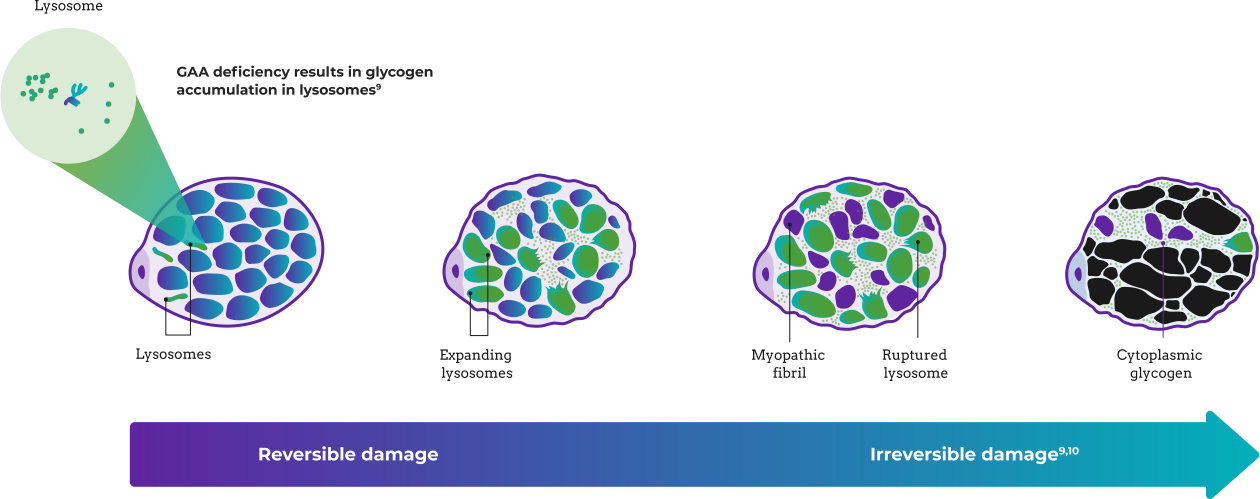
Illustration based on Thurberg BL, et al. Lab Invest. 2006;86(12):1208-1220.
Accumulation of glycogen can impact muscles that affect mobility, functional endurance, and breathing.1,2,9,10
Symptoms of LOPD
Pompe is a debilitating disease, and tissue damage can be irreversible3,11

Proximal muscle weakness3

13% per-year increased risk
of wheelchair dependency after diagnosis12

Respiratory muscle weakness13
.2025-04-16-05-27-16.svg)
8% per-year increased risk of ventilator
dependency after diagnosis12
Disease management
Management of Pompe disease is individualized based on patient needs. Enzyme replacement therapy (ERT) has been the standard of care since 2010.14
Ventilation, respiratory muscle training, physical therapy, breath training, nutrition, immunizations, and other approaches may all be part of the management plan.15
Coordination between different medical teams, such as neurology, genetics, pulmonology, gastroenterology, and cardiology, can be crucial for proper management.8
In March 2015, Pompe disease was added to the Recommended Uniform Screening Panel (RUSP). Since then, a number of states have added Pompe disease to their slate of diseases for their Newborn Screening (NBS) programs. As of May 2024, 44 states (plus the District of Columbia) have instituted NBS programs for Pompe disease.8
NEXVIAZYME-Treatment-landscape-popup-1
States that screen newborns for Pompe disease13*
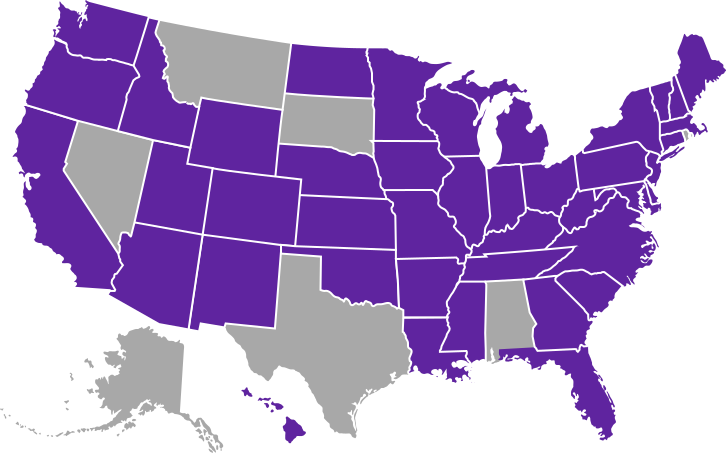
*Alabama and Texas are scheduled to add Pompe disease to their NBS panels in 2024 but have not as of May.
- Arizona
- Arkansas
- California
- Colorado
- Connecticut
- Delaware
- Florida
- Georgia
- Hawaii
- Idaho
- Illinois
- Indiana
- Iowa
- Kansas
- Kentucky
- Louisiana
- Maine
- Maryland
- Massachusetts
- Michigan
- Minnesota
- Mississippi
- Missouri
- Nebraska
- New Hampshire
- New Jersey
- New Mexico
- New York
- North Carolina
- North Dakota
- Ohio
- Oklahoma
- Oregon
- Pennsylvania
- Rhode Island
- South Carolina
- Tennessee
- Utah
- Vermont
- Virginia
- Washington
- West Virginia
- Wisconsin
- Wyoming

A look at the clinical trial
Discover how NEXVIAZYME, which was studied in the first pivotal, head-to-head ERT clinical trial in LOPD,16,17 may benefit your appropriate members.

Connect with us
Schedule a meeting with a member of the Sanofi Market Access team to learn more about Sanofi products.
References: 1. Chan J, Desai AK, Kazi ZB, et al. The emerging phenotype of late-onset Pompe disease: a systematic literature review. Mol Genet Metab. 2017;120(3):163-172. doi:10.1016/j.ymgme.2016.12.004 2. Kishnani PS, Amartino HM, Lindberg C, et al. Timing of diagnosis of patients with Pompe disease: data from the Pompe Registry. Am J Med Genet A. 2013;161A(10):2431-2443. doi:10.1002/ajmg.a.36110 3. Kishnani PS, Steiner RD, Bali D, et al. Pompe disease diagnosis and management guideline. Genet Med. 2006;8(5):267-288. doi:10.1097/01.gim.0000218152.87434.f3 4. Dasouki M, Jawdat O, Almadhoun O, et al. Pompe disease: literature review and case series. Neurol Clin. 2014;32(3):751-776, ix. doi:10.1016/j.ncl.2014.04.010 5. American Association of Neuromuscular & Electrodiagnostic Medicine. Diagnostic criteria for late-onset (childhood and adult) Pompe disease. Muscle Nerve. 2009;40(1):149-160. doi:10.1002/mus.21393 6. Xu M, Motabar O, Ferrer M, et al. Disease models for the development of therapies for lysosomal storage diseases. Ann N Y Acad Sci. 2016;1371(1):15-29. doi:10.1111/nyas.13052 7. Data on file. Sanofi. 2022. 8. Stevens D, Milani-Nejad S, Mozaffar T. Pompe disease: a clinical, diagnostic, and therapeutic overview. Curr Treat Options Neurol. 2022;24(11):573-588. doi:10.1007/s11940-022-00736-1 9. Thurberg BL, Maloney CL, Vaccaro C, et al. Characterization of pre- and post-treatment pathology after enzyme replacement therapy for Pompe disease. Lab Invest. 2006;86(12):1208-1220. doi:10.1038/labinvest.3700484 10. Raben N, Ralston E, Chien YH, et al. Differences in the predominance of lysosomal and autophagic pathologies between infants and adults with Pompe disease: implications for therapy. Mol Genet Metab. 2010;101(4):324-331. doi:10.1016/j.ymgme.2010.08.001 11. Toscano A, Rodolico C, Musumeci O. Multisystem late onset Pompe disease (LOPD): an update on clinical aspects. Ann Transl Med. 2019;7(13):284. doi:10.21037/atm.2019.07.24 12. Hagemans MLC, Winkel LPF, Hop WCJ, Reuser AJJ, Van Doorn PA, Van der Ploeg AT. Disease severity in children and adults with Pompe disease related to age and disease duration. Neurology. 2005;64(12):2139-2141. doi:10.1212/01.WNL.0000165979.46537.56 13. Fuller DD, ElMallah MK, Smith BK, et al. The respiratory neuromuscular system in Pompe disease. Respir Physio Neurobiol. 2013;189(2):241-249. doi:10.1016/j.resp.2013.06.007 14. Cupler EJ, Berger KI, Leshner RT, et al. Consensus treatment recommendations for late-onset Pompe disease. Muscle Nerve. 2012;45(3):319-333. doi:10.1002/mus.22329 15. Boentert M, Prigent H, Várdi K, et al. Practical recommendations for diagnosis and management of respiratory muscle weakness in late-onset Pompe disease. Int J Mol Sci. 2016;17(10):1735. doi:10.3390/ijms17101735 16. Straub V, Kishnani PS, Diaz-Manera J, et al. Efficacy and safety of avalglucosidase alfa in participants with late-onset Pompe disease after 145 weeks of treatment during the COMET trial. Poster presented at: Muscular Dystrophy Association Clinical & Scientific Conference; March 19-22, 2023; Dallas, TX. Poster 143. 17. NEXVIAZYME (avalglucosidase alfa). Prescribing information. Genzyme Corporation; 2021.
INDICATION
NEXVIAZYME (avalglucosidase alfa-ngpt) is indicated for the treatment of patients 1 year of age and older with late- onset Pompe disease [lysosomal acid alpha-glucosidase (GAA) deficiency].
Please see full Prescribing Information for complete details, including Boxed WARNING.
WARNINGS AND PRECAUTIONS
Hypersensitivity Reactions Including Anaphylaxis: See Boxed WARNING. Prior to NEXVIAZYME administration, consider pretreating with antihistamines, antipyretics, and/or corticosteroids. The risks and benefits of readministering NEXVIAZYME following severe hypersensitivity reaction (including anaphylaxis) should be considered. If a mild or moderate hypersensitivity reaction occurs, the infusion rate may be slowed or temporarily stopped.
Infusion-Associated Reactions: See Boxed WARNING. IARs may still occur in patients after receiving pretreatment. If mild or moderate IARs occur regardless of pretreatment, decreasing the infusion rate or temporarily stopping the infusion may ameliorate the symptoms.
Risk of Acute Cardiorespiratory Failure in Susceptible Patients: See Boxed WARNING.
ADVERSE REACTIONS
The most common adverse reactions (>5%) were headache, fatigue, diarrhea, nausea, arthralgia, dizziness, myalgia, pruritus, vomiting, dyspnea, erythema, paresthesia and urticaria.
INDICATION
NEXVIAZYME (avalglucosidase alfa-ngpt) is indicated for the treatment of patients 1 year of age and older with late- onset Pompe disease [lysosomal acid alpha-glucosidase (GAA) deficiency].
Please see full Prescribing Information for complete details, including Boxed WARNING.
WARNINGS AND PRECAUTIONS
Hypersensitivity Reactions Including Anaphylaxis: See Boxed WARNING. Prior to NEXVIAZYME administration, consider pretreating with antihistamines, antipyretics, and/or corticosteroids. The risks and benefits of readministering NEXVIAZYME following severe hypersensitivity reaction (including anaphylaxis) should be considered. If a mild or moderate hypersensitivity reaction occurs, the infusion rate may be slowed or temporarily stopped.
Infusion-Associated Reactions: See Boxed WARNING. IARs may still occur in patients after receiving pretreatment. If mild or moderate IARs occur regardless of pretreatment, decreasing the infusion rate or temporarily stopping the infusion may ameliorate the symptoms.
Risk of Acute Cardiorespiratory Failure in Susceptible Patients: See Boxed WARNING.
ADVERSE REACTIONS
The most common adverse reactions (>5%) were headache, fatigue, diarrhea, nausea, arthralgia, dizziness, myalgia, pruritus, vomiting, dyspnea, erythema, paresthesia and urticaria.
INDICATION
NEXVIAZYME (avalglucosidase alfa-ngpt) is indicated for the treatment of patients 1 year of age and older with late- onset Pompe disease [lysosomal acid alpha-glucosidase (GAA) deficiency].
Please see full Prescribing Information for complete details, including Boxed WARNING.
WARNINGS AND PRECAUTIONS
Hypersensitivity Reactions Including Anaphylaxis: See Boxed WARNING. Prior to NEXVIAZYME administration, consider pretreating with antihistamines, antipyretics, and/or corticosteroids. The risks and benefits of readministering NEXVIAZYME following severe hypersensitivity reaction (including anaphylaxis) should be considered. If a mild or moderate hypersensitivity reaction occurs, the infusion rate may be slowed or temporarily stopped.
Infusion-Associated Reactions: See Boxed WARNING. IARs may still occur in patients after receiving pretreatment. If mild or moderate IARs occur regardless of pretreatment, decreasing the infusion rate or temporarily stopping the infusion may ameliorate the symptoms.
Risk of Acute Cardiorespiratory Failure in Susceptible Patients: See Boxed WARNING.
ADVERSE REACTIONS
The most common adverse reactions (>5%) were headache, fatigue, diarrhea, nausea, arthralgia, dizziness, myalgia, pruritus, vomiting, dyspnea, erythema, paresthesia and urticaria.
This site is intended for US payers only.
© Sanofi. All rights reserved.
NEXVIAZYME is owned by Genzyme Corporation. NEXVIAZYME and Sanofi are registered trademarks of Sanofi or an affiliate.
CareConnect Personalized Support Services is a trademark of Sanofi or an affiliate.
Leave site modal

You are about to leave SanofiMarketAccess website.
Sanofi does not review or control the content of non-Sanofi websites.